



Introduction
When a fire breaks out in a building, industrial facility, or public space, the speed and effectiveness of the emergency response can mean the difference between a contained incident and a catastrophic loss of property or life. Among the many pieces of equipment that firefighters and emergency response teams rely on, the fire hose is one of the most fundamental — delivering the water or fire-suppressing agent from the source to the fire with the flow rate and pressure needed to bring a blaze under control. Understanding how fire hoses contribute to emergency response, what types are available, and what makes a good quality product helps procurement managers and facility owners make better decisions when equipping their fire protection systems. The Single Jacket Fire Hose is among the most widely used hose types across commercial, industrial, and municipal fire protection applications in the UAE.

The Basic Function of a Fire Hose
A fire hose is a flexible conduit designed to carry water or other fire-suppressing agents at the pressure and flow rate needed to deliver effective firefighting capability to the point of use. The hose connects a water source — typically a fire hydrant, standpipe riser, or fire pump outlet — to a nozzle through which the water is directed at the fire. The hose must withstand significant internal pressure without bursting, remain flexible enough for firefighters to manoeuvre it in confined spaces, and be durable enough to withstand the rough handling of emergency response conditions.
The key performance parameters of a fire hose are its working pressure rating, burst pressure rating, internal diameter, and length. These parameters determine the flow rate of water that can be delivered through the hose and the reach of the firefighting stream.
Types of Fire Hoses Used in Emergency Response
Single Jacket Fire Hose
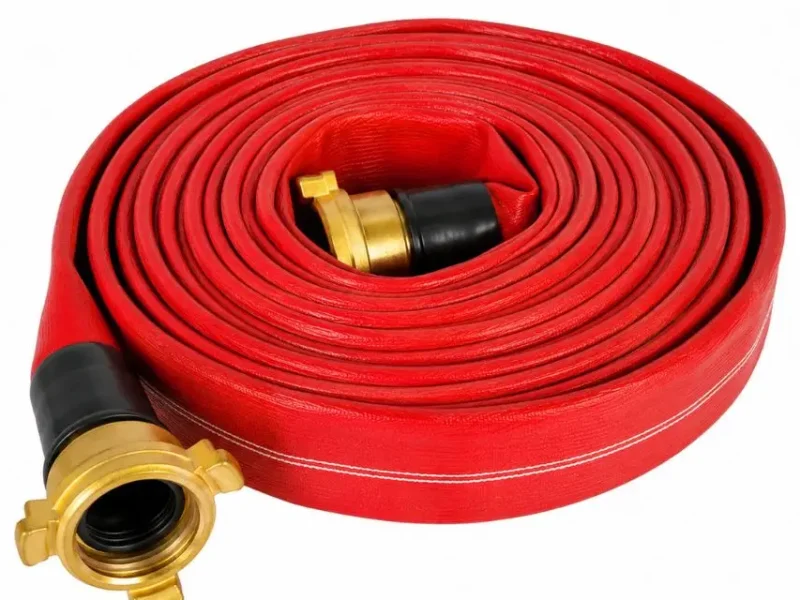
The Single Jacket Fire Hose has a single layer of woven fabric jacket over a rubber or synthetic liner. This construction makes it lightweight and flexible, which simplifies handling during emergency response. The single jacket design is commonly used in building fire protection systems — reel-mounted in fire hose cabinets on each floor of commercial and residential buildings — where the hose needs to be deployable quickly by building occupants or first responders before professional fire services arrive. The Single Jacket Fire Hose is suitable for moderate working pressures and provides reliable performance across a wide range of standard fire protection applications.
Double Jacket Fire Hose
The double jacket fire hose has two layers of woven fabric jacket, providing greater mechanical protection, higher pressure ratings, and longer service life in applications where the hose is subjected to heavy use, abrasion from rough surfaces, or particularly high-water pressures. Double jacket hoses are commonly used by professional fire brigades and in high-pressure industrial fire protection systems.
Suction Hoses
Suction hoses are rigid or semi-rigid hoses designed to draw water from open water sources — ponds, rivers, reservoirs, or tanks — into the intake of a fire pump. Unlike delivery hoses that carry pressurized water from a supply source, suction hoses must resist collapse under the negative pressure created by the pump’s suction action.
How Fire Hoses Integrate into Emergency Response Systems
In a well-designed emergency response system, fire hoses are part of an integrated network that includes water supply infrastructure, fire pumps, standpipe risers, hose reels, and hydrant connections. During an emergency, first responders connect hoses to the nearest available water supply point and advance toward the fire, deploying additional lengths of hose as needed to reach the seat of the fire.
The quality and condition of the fire hose directly affects how effectively this process works. A hose that is stiff from age or poor quality makes rapid deployment more difficult. A hose that fails at pressure during an emergency not only interrupts the firefighting effort but potentially endangers the responders relying on it. This is why specifying and maintaining high-quality hose products from reliable suppliers is a genuine safety-critical decision.
Also Read – Back to Basics: Exploring the Anatomy of Single Jacket Fire Hoses
Regular Inspection and Maintenance
Fire hoses should be inspected regularly — typically annually or after each use — for signs of wear, damage, or deterioration. Common issues to look for include cuts, abrasions, and cracks in the jacket or lining, damage to couplings and fittings, mildew or rot in natural fibre hoses, and delamination of the liner from the jacket. Hoses that show signs of significant damage or deterioration should be retired from service and replaced. Pressure testing to verify that the hose can safely withstand its rated working pressure is also an important part of a comprehensive maintenance program.

Conclusion
Fire hoses are an indispensable component of any effective emergency fire response system. From the Single Jacket Fire Hose installed in building fire hose cabinets to the heavy-duty double jacket hoses used by professional fire brigades, every hose in a fire protection system plays a role in determining how effectively a fire can be controlled and suppressed when it matters most. Specifying quality products from experienced suppliers and maintaining them properly ensures that your fire protection system performs reliably when an emergency occurs.